

01 — Standards
JIG & EI: The Rules of the Fuel
Two bodies set the international rules for aviation fuel. The Joint Inspection Group (JIG) publishes the operating standards for how fuel is received, stored, checked and put into aircraft; the Energy Institute (EI) publishes the technical specifications that qualify the equipment — most notably the filter/water-separators and filter monitors that keep product clean and dry.
Operators specify JIG and EI because they make fuel quality a shared, auditable language across the world: the same cleanliness targets, the same equipment qualification and the same operating discipline apply at every compliant airport. Building to them is what makes a facility insurable, inspectable and safe to hand over. Every fuel-facility we design carries the relevant JIG and EI requirements from the first drawing.
02 — Quality
Keeping Jet A1 Clear, Bright & Dry
Jet fuel fails aircraft in two ways: solid particles and water. Quality control is the discipline of removing both — and proving they are gone before a drop reaches a wing.
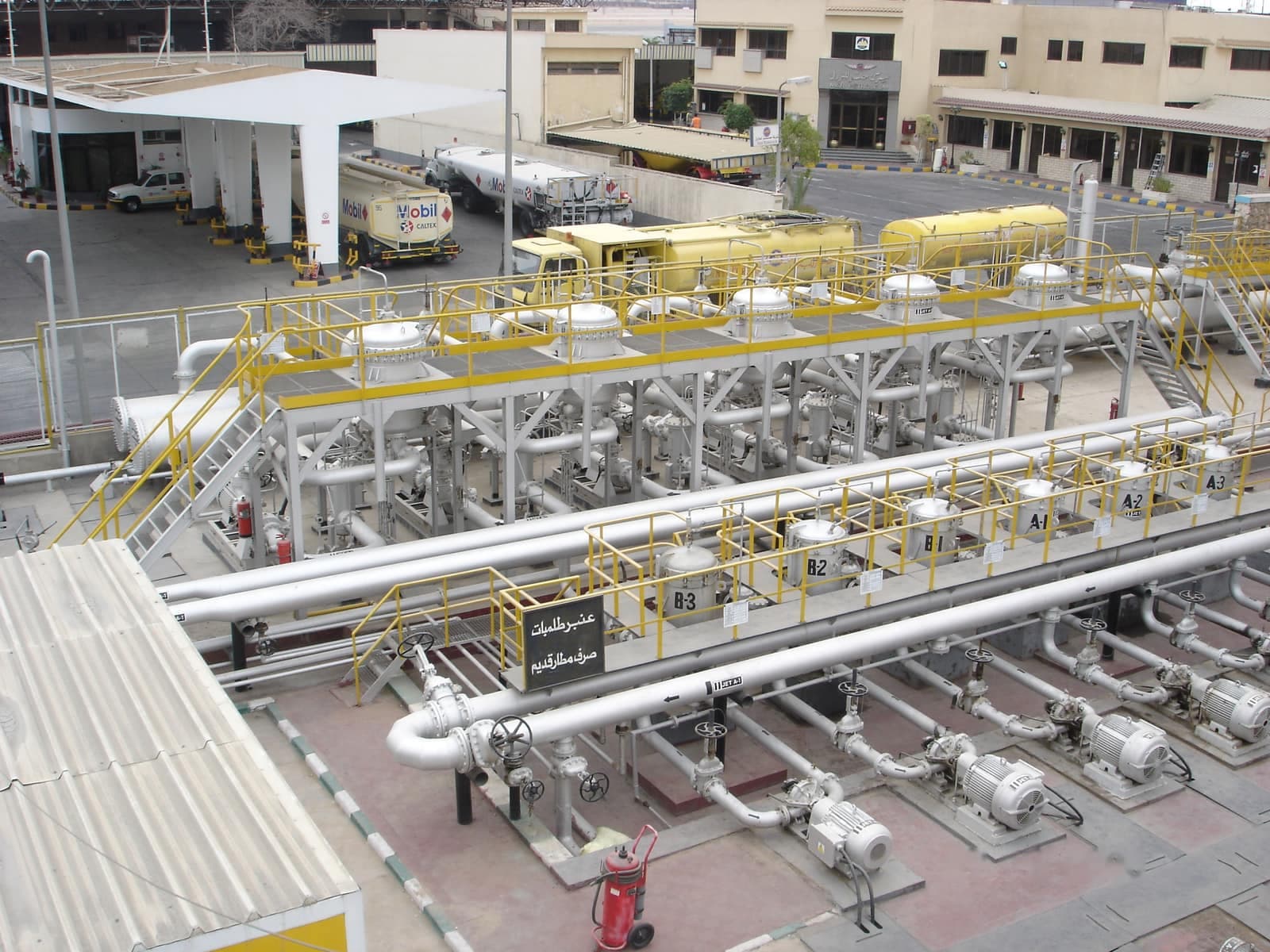
Filtration & separation. Fuel passes through filter/water-separators that coalesce fine water droplets and strip particulates, and through filter monitors as a final safeguard — so what leaves the facility is clear (no haze), bright (no free water) and dry.
Settling & suction. Storage tanks use floating suctions to draw from the cleanest fuel near the surface, while water and sediment settle to the low point to be drained — a quiet, continuous form of quality control.
Sampling & testing. Routine sampling checks appearance, density and free water; membrane (millipore) and free-water tests put a number on cleanliness. Fuel is not released until the records say it is on spec.
03 — Delivery methods
Hydrant Systems vs Refuellers
There are two ways to get fuel from the farm to the aircraft. Which one fits depends on how busy the apron is.
Hydrant Systems
A buried network of pipelines feeds pit valves at each stand; a compact dispenser connects the pit to the aircraft. Best for busy terminals with fixed stands — high throughput, no tanker traffic and no on-apron fuel storage, at the cost of a larger fixed installation.
Refuellers
Tanker vehicles carry fuel and filtration to the aircraft. Best for lower traffic, remote stands or flexible layouts — quick to deploy and easy to relocate, but limited by tanker capacity and apron movements. Many airports run both, hydrant on the main stands and refuellers everywhere else.
04 — The facility
Anatomy of a Fuel Farm
A fuel farm is a chain of stages, each protecting the next. Follow the fuel from the road to the aircraft.
- 01
Receipt
Fuel arrives by tanker or pipeline, is checked and filtered on the way in.
- 02
Storage
Held in bulk tanks with floating suction and settling, monitored by tank gauging.
- 03
Filtration
Filter/water-separators and monitors take out particulates and water.
- 04
Metering
Flow is measured accurately for custody transfer and control.
- 05
Dispatch
Clean fuel goes to the hydrant loop or into a refueller — receipt to wing.
Explore further